Author: Thorsten Hofmann, C4 Institute, Quadriga University Berlin
Thorsten Hofmann leads the CfN (Center for Negotiation) at the Quadriga University Berlin’s Institute for Crisis, Change and Conflict Communication C4. He is an internationally certified Negotiation Trainer and advises corporations and organisations in complex negotiation processes.
Do you also encounter viewpoints in negotiations that seem completely incomprehensible to you? A position or demand that makes you wonder, “How can anyone believe such a thing in the face of the actual facts?” Surely you can think of an example right away.
Trump setzt Europa mit Strafzöllen unter Druck, um Grönland zu bekommen. Es geht nicht um Handel, sondern um Erpressung. Warum die EU jetzt standhaft bleiben muss – sonst wird diese Methode zur neuen Norm.
Many people perceive things as “true” in negotiations that are often not based on facts but on prejudices or assumptions, creating a “fallacious truth”. This leads to emotionalized decisions. Modern brain research explains why this is particularly dangerous in negotiations.
Negotiations can often become a psychological test of strength. Perhaps you are familiar with this as well. Unfair psychological tricks, the use of authority and personal pressure can cause stress and put you on the defensive. You lose control of the negotiation.
We love talking in negotiations: about us, what we want, why we want it and even more about how the other side’s desires are nonsense. However, on the other side of the table sits the source of information that I can use to improve my outcome. I just have to get the source to bubble.
We are all natural born questioners as children. We keep asking and asking and take nothing for granted. An ability that many of us have forgotten in adulthood.
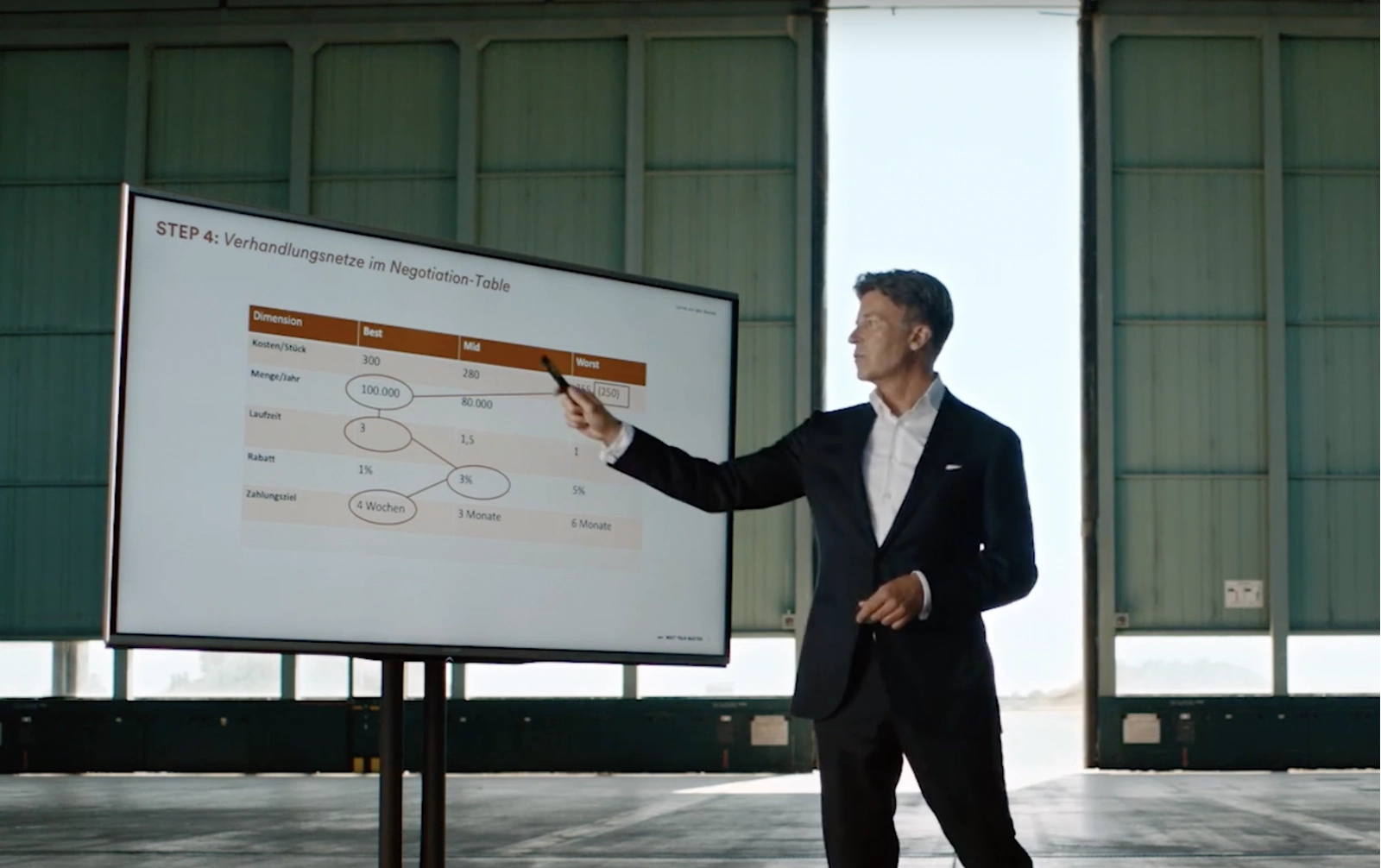
To successfully achieve your negotiating goals, you need to prepare strategically for negotiations. An important tool for this is the structure of the negotiation table.
Negotiations can be a real challenge. Whether it’s negotiating in the business world, in politics, or when buying a car, they are often decided by emotions. This is where emotional intelligence (EI) comes into play.
You are currently viewing a placeholder content from Turnstile. To access the actual content, click the button below. Please note that doing so will share data with third-party providers.
You are currently viewing a placeholder content from Facebook. To access the actual content, click the button below. Please note that doing so will share data with third-party providers.
You are currently viewing a placeholder content from Instagram. To access the actual content, click the button below. Please note that doing so will share data with third-party providers.
You are currently viewing a placeholder content from X. To access the actual content, click the button below. Please note that doing so will share data with third-party providers.